How to Draw Liu Kang

With this tutorial, you will learn how to draw Liu Kang, one of the earliest and most iconic characters in the Mortal Kombat series.
Alongside Sub-Zero and Scorpion, Liu Kang appeared in the very first game of the series and was also the main character in the original 1995 Mortal Kombat film. In this drawing tutorial, we will show the version of the character based on that film.
Here, we will use all the methods of person drawing and human construction to create a realistic, volumetric image.
How to draw Liu Kang step by step
Step 1: Sketch the head, spine, and torso axis
Start with the body framework, indicating the character’s position and pose on the page. First sketch the head with light lines, then draw the line of the spine. Use two light horizontal lines to mark the shoulders and the pelvis – the angle between these two lines determines the tilt of the torso.

Step 2: Sketch the arm and leg guidelines
Next, indicate the arms using light lines, placing them in a fighting stance. From the horizontal line of the pelvis, sketch the legs spread to the sides, also in a ready-to-fight pose. Check the body proportions and make sure they look natural, and that the figure stands firmly on the page.

Step 3: Sketch the head and torso masses
Using the framework and basic outlines, begin adding volume to Liu Kang’s drawing. First, indicate the placement of the eyes and facial features with very light, barely visible lines. Then sketch the overall mass of the long hairstyle, again without going into detail. Give the neck and torso volume, taking the turn of the body into account.

Step 4: Draw the arms and hands of Liu Kang
Mark the shoulders with spherical forms, then sketch the arms as cylinders and the elbows as rounded joints. Without adding extra detail, block in the hands, giving them their general shape and angle. As you draw the character, remember that you are creating three-dimensional forms – body parts are not flat, but volumetric.

Step 5: Sketch the lower body of the fighter
Now use rough, general lines to add mass to the legs, outlining the pants and the feet. Pay attention to the angle of each leg and the direction it is facing. Before moving on to detailing, check the proportions once again and compare the relationships of the body parts to the overall figure and to each other.

Step 6: Draw the face of Liu Kang
Taking Liu Kang’s pose into account, you need to draw the face in side view using the construction lines. First sketch the outline of the eye, then define the nose and the contour of the face. Add the mouth and the jaw. As you work, continue comparing the parts to one another and adjust the proportions if needed.

Step 7: Complete the hair mass
Refine Liu Kang’s hairstyle by carefully outlining it with cleaner lines, defining the locks, and erasing the construction lines. When drawing the hair, do not try to depict every strand individually; instead, group them into larger sections. The texture should not be drawn randomly – rather, indicate highlights and emphasize individual locks where needed.

Step 8: Outline the upper body of the fighter
When working on the torso, begin by outlining the visible muscles with smoother lines, keeping the torso muscles anatomy in mind and remembering that the forms you draw are three-dimensional. Then define the outline of the tank top and add folds in the lower area.

Step 9: Detail Liu Kang’s arm muscles
Also keep the anatomy of the upper limbs in mind, carefully rendering the deltoids, biceps, triceps, and forearms. Indicate the placement of the muscles, giving them a tense, ready-for-combat appearance.

Step 10: Draw the hands of Liu Kang
Using the previously sketched outlines as a guide, draw the hands of Liu Kang in detail. First define the base of the palms, then refine the fingers. Do not go too deep into small bends, folds, and minor details – focus on larger, more general forms so as not to draw unnecessary attention.

Step 11: Refine the fighter’s lower body
The belt tightened around the torso compresses the fabric of the pants and creates vertical folds. Draw them following the form of the legs, running from top to bottom. Outline the pants themselves, adding folds where they gather at the bottom.

Step 12: Draw the shins and feet of Liu Kang
Refine the outlines of the ankles and feet, carefully erasing the construction lines sketched earlier and giving the legs a symmetrical look while accounting for their different angles. Draw the overlapping wraps around each shin of Liu Kang.

Step 13: Draw shadows on the fighter’s figure
To emphasize the volume of the figure and its individual parts, add shading. Remember that Liu Kang and all parts of his body are three-dimensional; taking this and the direction of the light into account, define the separation between light and shadow, then fill the shadow areas with smooth, clean hatching. Add highlights to the hair as well, using hatching that follows the flow and direction of the strands.

Key points for drawing Liu Kang realistically
Drawing characters from Mortal Kombat, regardless of whether they are based on film or game versions, requires the ability to draw the human figure realistically.
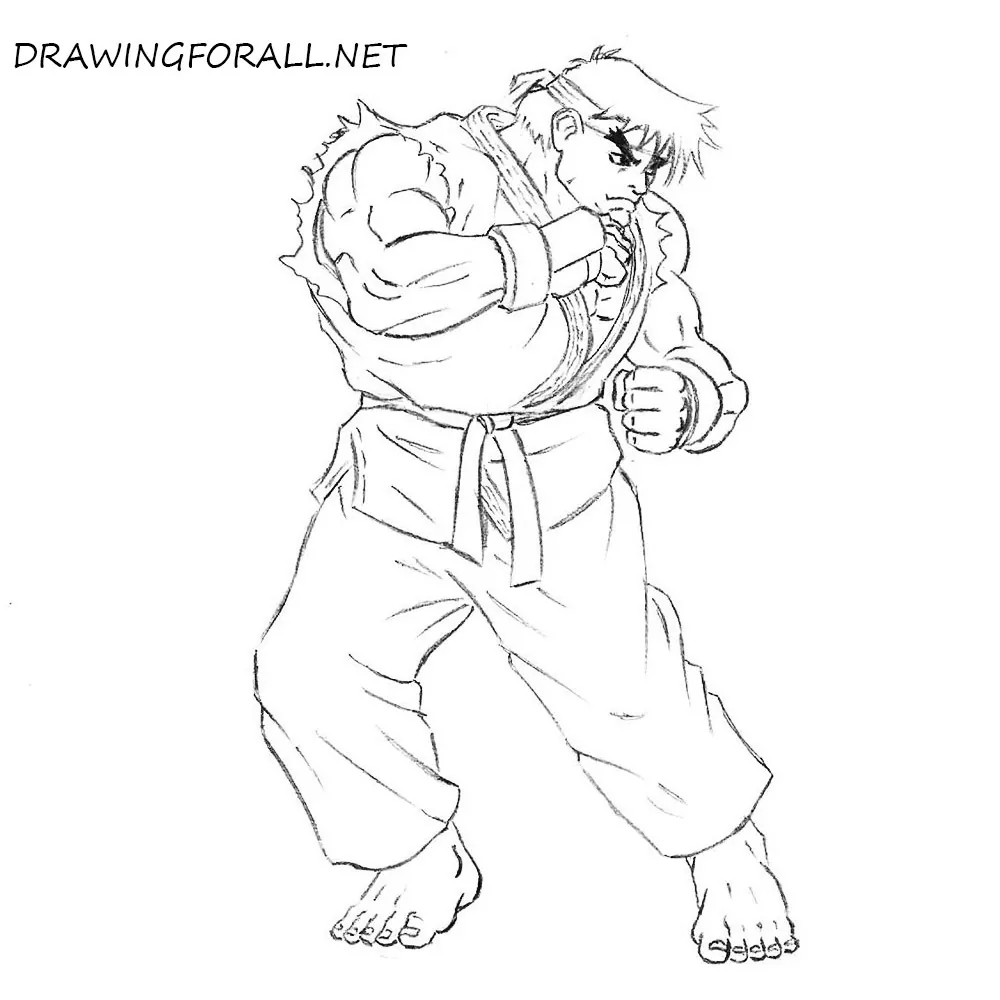
Unlike Street Fighter, where characters are often more two-dimensional and anime-like, Mortal Kombat has always aimed for maximum realism from the very beginning. Even the earliest games released in the early 1990s were based on digitized recordings of real human movement.
Because of this, it is essential to have a strong understanding of drawing fundamentals if you want to create truly convincing characters.
We have covered these basics in our basic drawing course. At the same time, it is important to keep in mind the individuality with which the creators approached each character.
For example, in our Sub-Zero drawing tutorial and Scorpion drawing guide, we examined in detail the principles behind designing ninja characters from this universe. The approach here is very similar.
Any Mortal Kombat character is designed to look as convincing as possible, even when the design itself is fantastical, such as Goro with his four arms, which is still built with believable structure and detail.
This combination of realism and unusual design allows the viewer to accept what is happening on screen. It is exactly this level of realism and credibility that you should aim to convey in your drawings.

In addition, each Mortal Kombat character is dressed in traditional or semi-traditional clothing, often with mystical accessories and cultural references.
These elements make the characters not only visually convincing but also distinctive and charismatic. Liu Kang, for example, is a layered blend of a Shaolin monk archetype and the image of Bruce Lee.