

How to Draw Male Eyes

This tutorial will teach you how to draw male eyes using classical methods and will also explain important distinguishing features used in academic drawing.
Of course, people are very diverse, and our eyes differ greatly from one another. In many cases, male eyes may not differ from female eyes at all.
However, in classical drawing, and especially in stylized directions such as comics, anime, or animation, there are clearly defined principles and methods for drawing male and female eyes.
This is necessary to make characters more expressive and to emphasize features that are artistically important.
Based on the basic eye drawing tutorial, this guide will also show additional aspects of expressiveness and explain how to practice the skill for greater confidence.
How to draw male eyes step by step
Step 1: Draw vertical and horizontal eye guides
As noted earlier, eyes can vary greatly, but the process of drawing male eyes is no different from drawing any other eyes. Start by sketching a vertical line that divides the face into two equal parts. Next, sketch a horizontal line to help maintain the proportions. It usually runs through the center of the eyes, but here we placed it slightly lower.

Step 2: Draw the upper eyelids of the male eyes
On the horizontal line, mark the inner and outer corners of the eyes. Keep in mind that the width of each eye should be approximately equal to the distance between them. Next, connect the inner and outer corners of each eye to define the edge of the upper eyelid. Here you can use slightly firmer and more angular lines than you would when drawing female eyes.
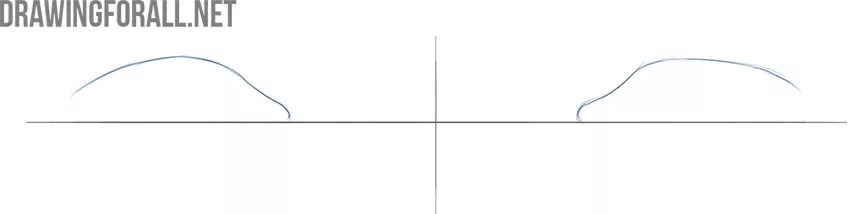
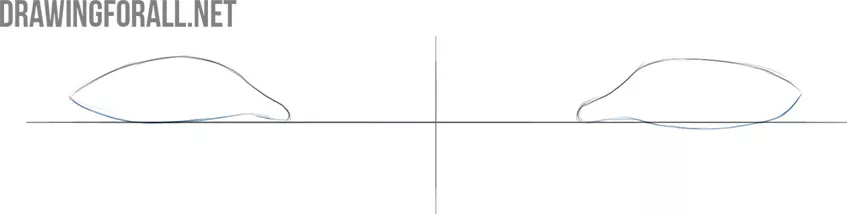
Step 3: Sketch the lower eyelids and lacrimal caruncles
Now draw the lower eyelids using the same smooth lines, specifically outlining the outer edges of the lower eyelids. At this stage, it is also very important to sketch the outlines of the lacrimal caruncles so that your drawing of the male eyes looks more natural and convincing later. You can make the eye shape slightly more angular and the squint more pronounced.
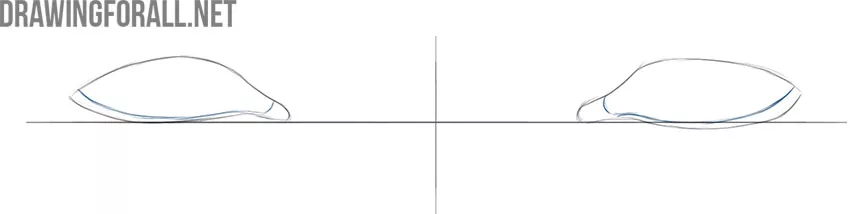
Step 4: Draw the inner eyelid edges of the eyes
Now draw the inner edges of the lower eyelids with a couple of smooth lines. The eyelids have thickness that should be conveyed in the drawing. It is extremely important to depict dimensional eyelids, as in our example, to achieve maximum naturalness in the eyes.
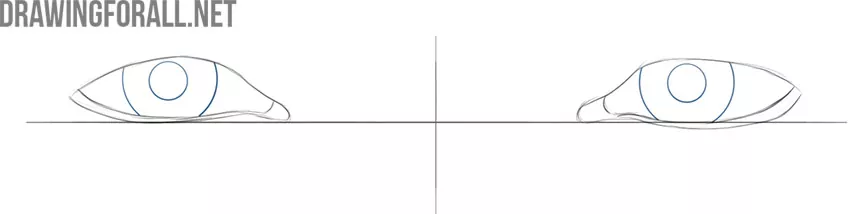
Step 5: Draw the irises and pupils of the eyes
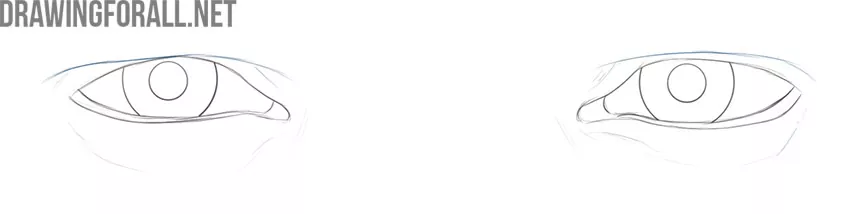
First, draw the outlines of the irises, which are slightly covered by the upper and lower eyelids. The wider the eye opening, the more visible the irises will be. Next, draw the pupils as two perfect circles. The pupils should be positioned exactly in the center of the irises.
Step 6: Sketch the eyelid folds and erase guidelines
The eyes are essentially spheres set inside cavities. At this step, draw the outlines of the eye sockets visible beneath the skin. While adding the details and folds, constantly compare the parts with each other to achieve the most accurate proportions. Do not forget to erase all construction lines from your male eyes drawing.
Step 7: Add tone and shadows to the eyes
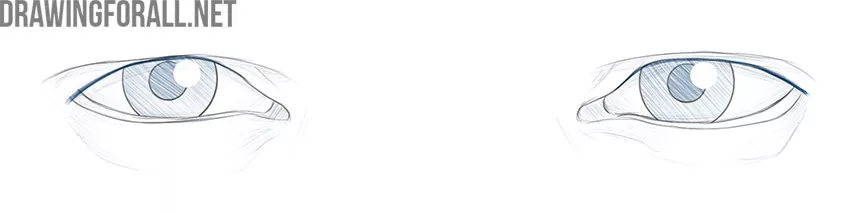
Add shadows to your drawing of male eyes for more realism and volume. Using hatching, very carefully and smoothly shade the pupils, then the irises. Next, sketch out shadows in the darkest areas and gradually move towards lighter ones. Darken the upper lid lines to define the lashes. Erase small circular areas at the junction of the pupils and irises to indicate the highlights.
Step 8: Complete and refine the drawing of eyes
The drawing should be cohesive and complete, without details that clearly stand out from the overall image, and without errors in perspective or tonal relationships. Check this and make additional adjustments if necessary. For example, you can increase the contrast in your drawing and add additional layers of hatching to achieve a more dimensional result.

Key nuances of drawing male eyes
Let’s now go over the nuances that are especially important when you want to draw male eyes and convey this clearly.
Since ancient times, beginning with Antiquity, artists have been able to distinctly convey the necessary traits in their drawings and sculptures.
This was achieved through a number of characteristic techniques, many of which involved exaggeration and simplification.
Some of them were already mentioned in the tutorial itself, particularly those most important during the drawing process. Now let’s discuss additional aspects that are also very important.
For example, when drawing a male face or figure, slightly firmer and more defined lines are often used, while classical antique sculptures and Renaissance artists typically used softer, smoother lines when depicting women.
This also applies to drawing eyes. The outlines and contours are equally important, and these are best studied by observing many references or drawing from imagination.
When drawing male eyes, you can also make the eyelashes less pronounced and, if you draw them, the eyebrows thicker.
Now you can try drawing several pairs of male eyes using our references, slightly varying the outlines and shapes.

While drawing, remember the principles of artistic vision and the fact that the eyes are spheres covered by the skin of the eyelids.
In our sphere drawing tutorial, we explained how to create such volumetric forms. It is also important to keep the anatomy of the eye in mind if you want to achieve more convincing results.
After you learn how to draw male eyes from the front, try depicting them from different angles. For example, you can draw the eyes in a three-quarter view while preserving the characteristic features, or use a side view.

The next logical step is drawing the entire face. For example, you can draw a male face using the principles shown in this tutorial. The same principles are also suitable for drawing a boy’s face in detail, clearly depicting the eyes.

And as always, it is important to remember that the key to learning drawing is regular practice. Try not only to create complex, detailed drawings, but also make quick sketches, capturing the gaze and emotion while conveying the characteristic features you want to show in your work.


