

How to Draw a Cube
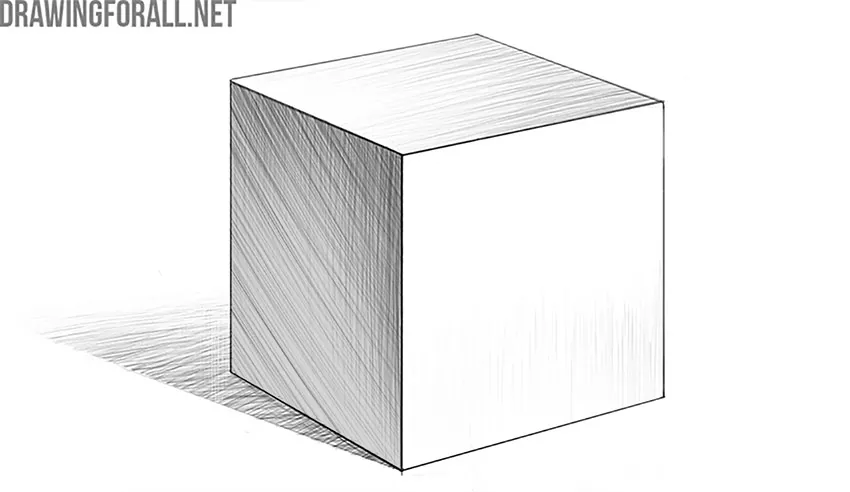
In this tutorial, we will show you how to draw a cube. With this tutorial, you can also learn how to practice drawing perspective and straight lines.
In order to correctly and accurately construct a cube, it is necessary to understand and imagine its volume. That is, when creating this geometric figure, you must clearly understand where and at what angle its sides are located and how they recede in perspective.
In fact, there are a huge number of different ways to draw a 3D cube, and in this article, we will show you one of them. In the future, we will show you some other ways of drawing this geometric body.
How to draw a cube step by step
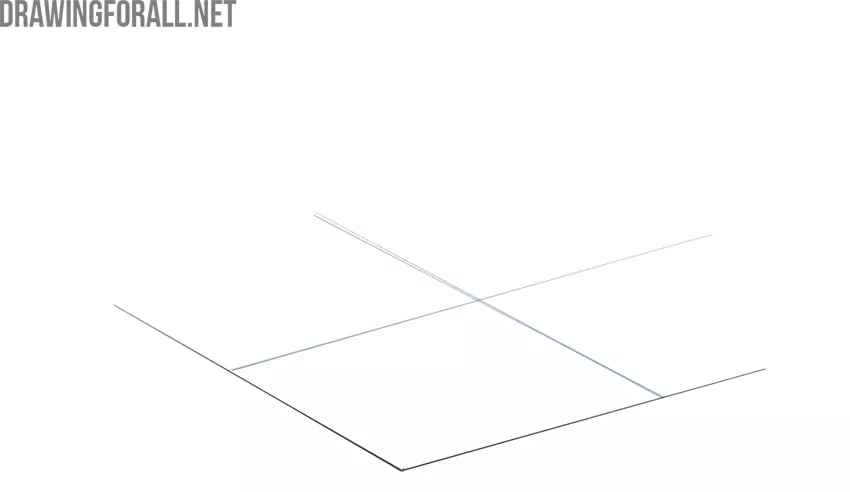
Step 1: Sketch the bottom edges
First, sketch the bottom edges of the cube. In order not to make a mistake with the angles, use the sighting method, which we told you about in the article on linear perspective. Try to use very light lines and avoid using a ruler.

Step 2: Add the hidden edges
Now, using very light lines, sketch two more edges of the cube that are not visible to us. We draw these lines to avoid mistakes in the angles and overall shape of the figure. Recall that, according to the rules of linear perspective, the receding lines should gradually move closer together.
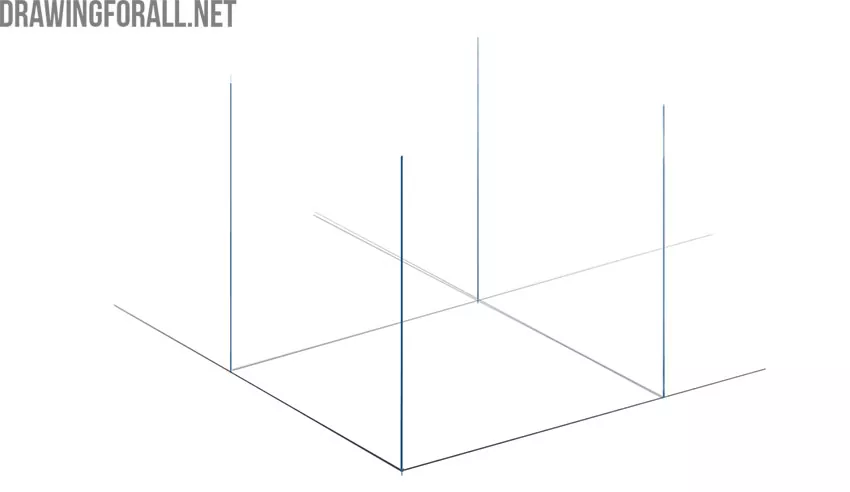
Step 3: Draw the vertical edges
Now, using four straight vertical lines, sketch the vertical edges of the cube. Recall that, according to the basics of drawing, the lines located closer to us should be darker and have more contrast than the lines located farther away.
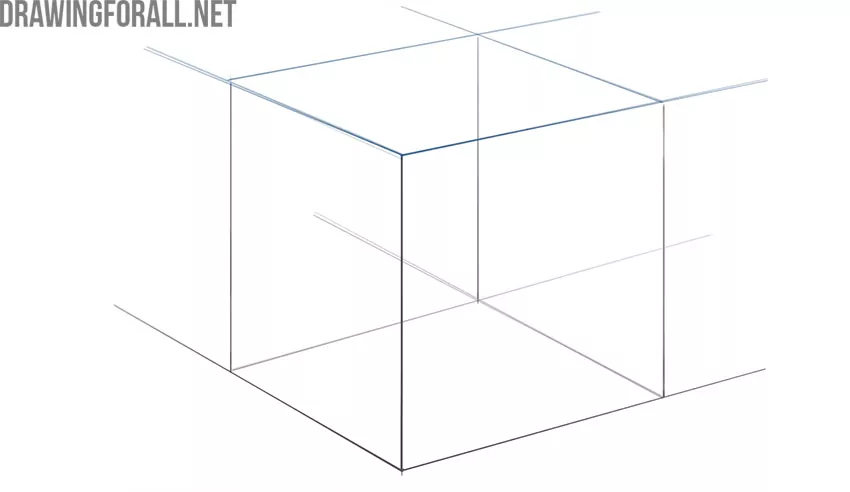
Step 4: Complete the top edges
Now, using four straight lines, draw the top edges of the cube. Note that the top face should appear flatter than the bottom one. Recall again that the receding lines should move closer together and lose contrast. This will help your cube drawing look more three-dimensional and realistic.
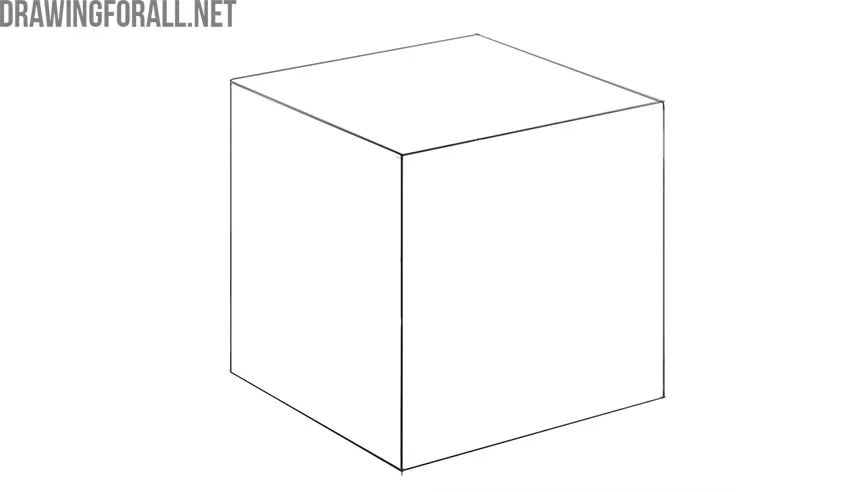
Step 5: Refine the cube outline
To give the geometric structure a more finished look, remove the unnecessary construction lines and make the remaining lines clean and clear. Do not forget to correct any errors in the lines and perspective, because they will be more difficult to fix later.
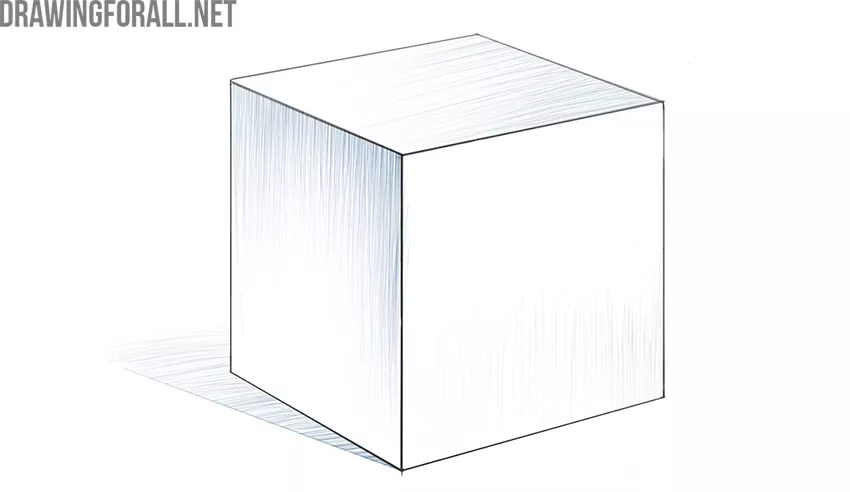
Step 6: Add shadows to cube
Now it is time to give the cube drawing volume and make it truly three-dimensional. To do this, begin applying shadows. We described in detail how to draw shadows in our article about drawing light and shadow.
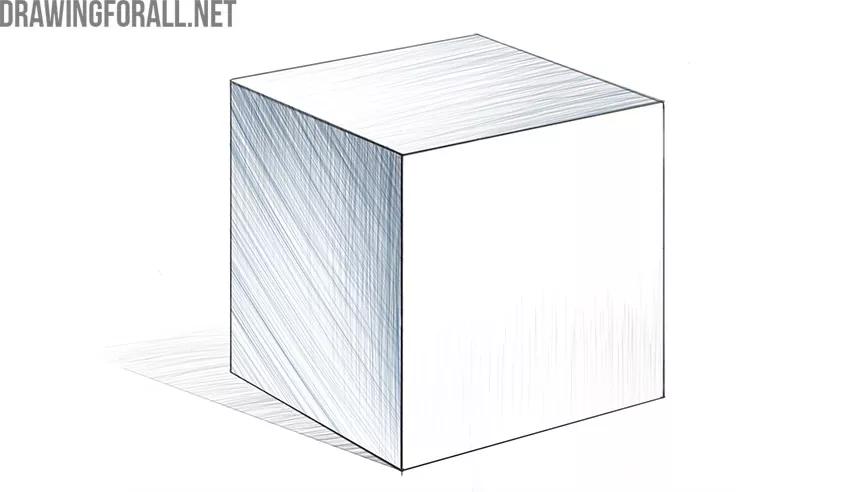
Step 7: Deepen the cube shading
Continue adding layers of hatching, darkening them where needed. Increase the contrast at the boundary between light and shadow and in the areas closest to us. We used fairly visible hatching here, but you can make it neater and smoother.
Step 8: Finish the cube drawing
Finally, look over your artwork, find any errors, and correct them if possible. Add any necessary finishing touches, and your cube drawing is done!
Recall that this article is useful not only for those who want to learn how to draw a cube but also for learning how to correctly understand perspective and create cubic objects.
All complex objects surrounding us are based on simple geometric shapes, one of which is a cube. By learning to depict this simple geometric figure accurately, you will greatly improve your drawing skills.


I like this