How to Draw Eyes from the 3/4 View

This basic, fundamental tutorial will show you how to draw eyes from the 3/4 view while maintaining proper proportions and perspective.
This tutorial is part of our series showing how to draw eyes from different angles. Drawing eyes is an essential skill for any artist, because to draw a person correctly, you need to be able to illustrate this part of the face accurately.
This tutorial on how to draw eyes in three-quarter view will be especially useful for artists who want to learn how to create convincing portraits.
How to draw eyes from the 3/4 view step by step
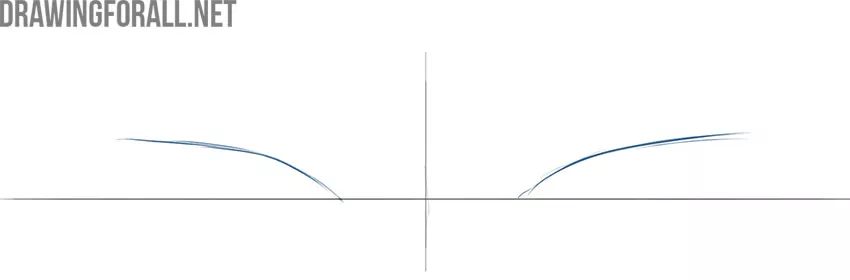
Step 1: Sketch the eye symmetry guidelines
Start drawing the eyes by sketching a vertical line of symmetry. This line runs through the center of the face and divides it into two parts. Next, draw a horizontal line that passes roughly through the center of the eyes, or through the lacrimal caruncles. At this stage, you should already indicate the turn of the face by shifting the center line.

Step 2: Mark the eye and eyebrow positions
Now, using very light strokes, sketch the guidelines for the upper and lower edges of the eyes. Then, at the top, indicate the eyebrow line. These lines help not only to draw the details correctly but also to maintain proper proportions. Note that according to the rules of linear perspective, the guidelines should spread farther apart as they move closer to the viewer.

Step 3: Draw the shapes of the eyes and nose
Using very light lines and guided by the guidelines from the previous steps, sketch the outlines of the eyes, eyebrows, and nose. The distance between the eyes should be approximately equal to the width of one eye. In accordance with the rules of linear perspective mentioned above, the details closer to us should appear larger than those that are farther away.

Step 4: Define the eyelids and eye contours
Now it is time to move on to the details and give the eye drawing a more finished appearance. First, carefully define the outlines of the eyes, then draw the upper and lower eyelids. Be sure to indicate the visible lacrimal caruncle as well. Also keep in mind that you can check the proportions and overall accuracy of the eye drawing by looking at it in a mirror.

Step 5: Sketch the eyelid folds and eyebrows
Draw the folds around the eyes with smooth lines. Next, sketch the eyebrows and the bridge of the nose. To make the eye drawing look more lively and realistic, indicate the folds between the eyebrows. Do not forget to constantly compare the parts of the drawing with each other and the entire drawing with the example to avoid mistakes and correct those that have already been made.

Step 6: Refine the eyes and erase the guidelines
Now, using very light strokes, sketch the guidelines for the upper and lower edges of the eyes. Then, at the top, indicate the eyebrow line. These lines help not only define the details correctly but also maintain proper proportions. Note that, according to the rules of linear perspective, the guidelines should spread farther apart as they move closer to the viewer. In accordance with the rules of atmospheric perspective, the lines should become slightly lighter as they recede into the distance.

Step 7: Draw the irises and pupils inside the eyes
Now it is time to draw the pupils. First, define the outlines of the irises, whose upper portions are slightly covered by the upper eyelids. Then, very carefully draw the pupils. The pupils should be perfectly round, so be sure to check their shape and proportions by looking at the drawing in a mirror.

Step 8: Draw shadows on the eyes
The drawing of the eyes is almost complete, and it is time to make them truly volumetric. To do this, add shadows using hatching. To apply the shadows correctly and cleanly, we recommend studying our article on light and shadow.

Step 9: Check proportions and unify the drawing
Now review, correct if necessary, and unify your entire three-quarter view eye drawing. All elements should look convincing and realistic. Proportions, symmetry, and consistency with both atmospheric and linear perspective are also very important for making the drawing appear more lifelike.

Key features of drawing eyes in three-quarter view
The eyes, like any part of the human body and any object in space, follow the laws of linear perspective.
Any object turning left or right relative to the viewer will appear visually distorted, and this is the first thing to keep in mind when drawing a face in three-quarter view.
If a person looks directly at us, both eyes appear the same size and strong perspective distortion is not noticeable.
However, as the head turns to the side, the part of the face that moves closer to the viewer, along with all the features on it, will appear slightly larger than the part moving away.
Thus, eyes in three-quarter view follow the same perspective rules as any other object. To visualize this, draw perspective lines passing through key points in the eye area.

Each individual eye, while following the overall surface on which it is placed – the front plane of the face – must also follow perspective as it turns in space.
This means that each eye appears slightly larger on the side closer to the viewer and smaller on the far side.
When drawing eyes in three-quarter view, it is also important to remember the structure of the eye: a sphere covered by volumetric eyelids.
These elements create additional volume when rotated, which must be taken into account. The eye should be treated as a spherical form rather than a flat shape, and the eyelids should have thickness instead of appearing as a flat texture.

It is also important to keep all elements unified when drawing eyes in three-quarter view, whether separately or on the head.
The volumes and forms of the eyes should clearly follow the volume and structure of the head, as well as the perspective created by the turn.
A sense of volume and convincing appearance is achieved through the unity of all elements in the drawing. For this reason, it is important to train your artistic vision and see objects not as flat lines, but as three-dimensional forms, looking through the details and elements.

To further improve your skills in drawing eyes in three-quarter view, try drawing them facing the opposite direction using the steps from this tutorial.
Next, draw different eyes, for example your own. This will help train your artistic vision and deepen your understanding of perspective and anatomy.
You can also try using different lighting setups to make the task more challenging. Most importantly, try drawing the entire head along with the eyes and other facial features, placing all parts of the face correctly and proportionally.