

How to Draw an Ear
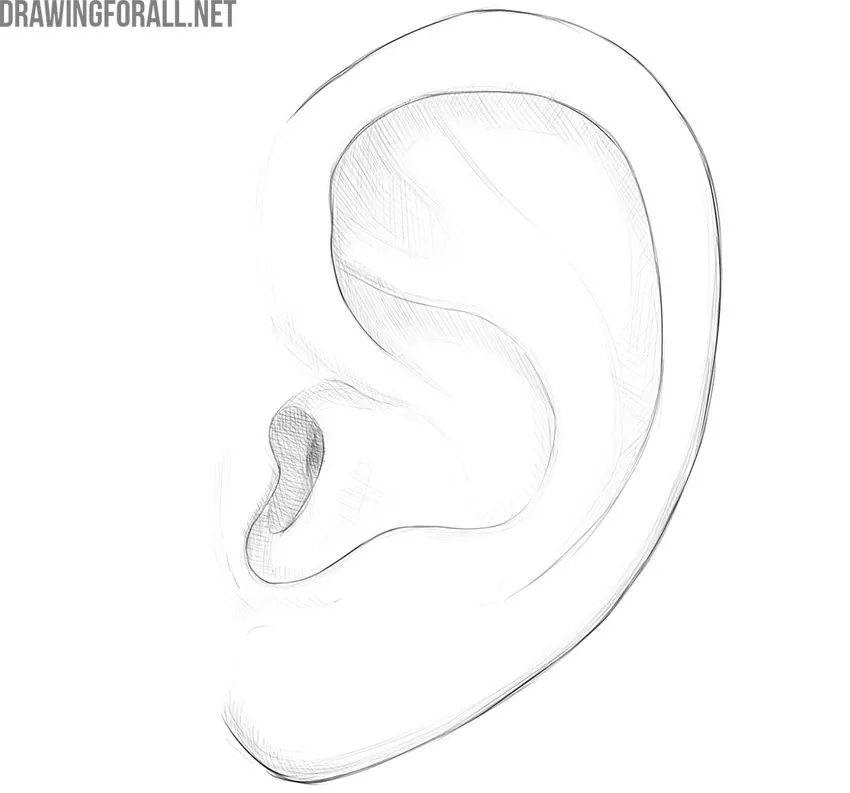
In this fundamental tutorial, we will show you how to draw an ear step by step. Like other drawing tutorials about parts of the face, this guide occupies an important place in learning how to draw portraits.
First of all, the ability to draw an ear is important if you want to portray a face. You cannot draw a convincing and realistic face if you do not know how to construct the facial features.
It will be useful to begin by studying our article about the ear anatomy for artists, at least in general terms. This will help you understand the main forms of the ear instead of simply copying its contours onto paper.
How to draw an ear step by step
Step 1: Sketch the ear boundaries
First, sketch the edges of the ear. Find its boundaries and roughly outline its overall volume on paper. As with all the first steps, use very light pressure on the pencil here.

Step 2: Draw the outer contour
Now draw the entire outer contour of the ear with a very smooth line, using the marks from the first step. Ears have different shapes, and this tutorial shows a general approach that you can adapt to ears of different shapes.

Step 3: Outline the lower helix
Using a long, smooth line, draw the lower edge of the helix. As you draw the ear, constantly compare its parts so you can spot mistakes and correct them.

Step 4: Add the inner cartilage
Now draw the antihelix, tragus, and antitragus with long, smooth lines. We discussed all these parts in our article on ear anatomy. Keep in mind that these parts and details can vary greatly from person to person.
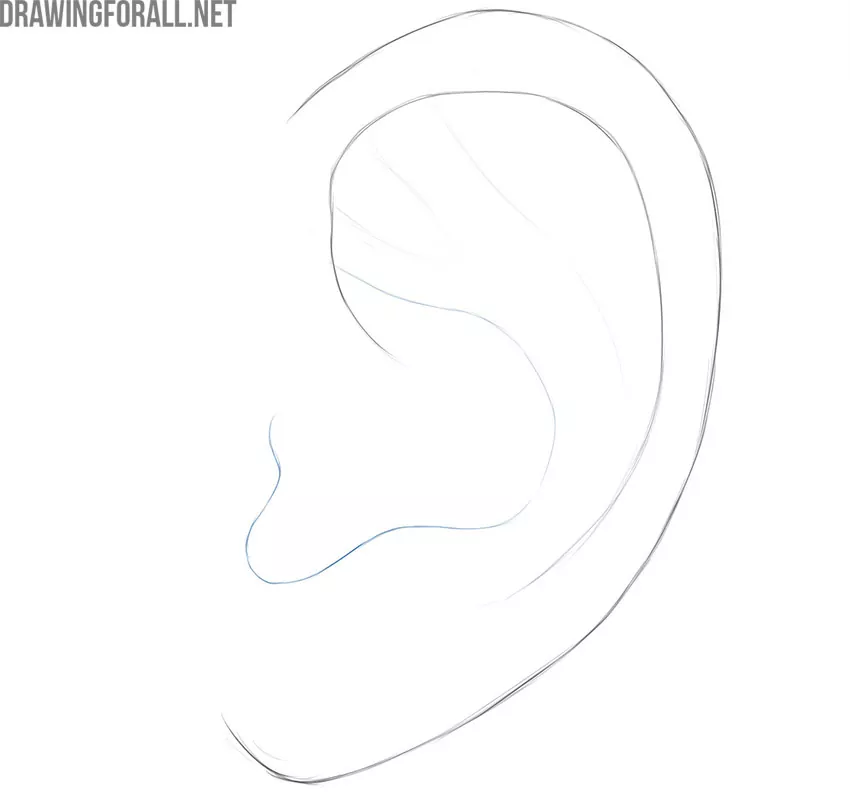
Step 5: Draw the ear canal
Draw the opening of the ear canal and the remaining ear cartilage. As you add these details, make sure they are the correct size and relate naturally to one another. Keep comparing the different parts as you work.
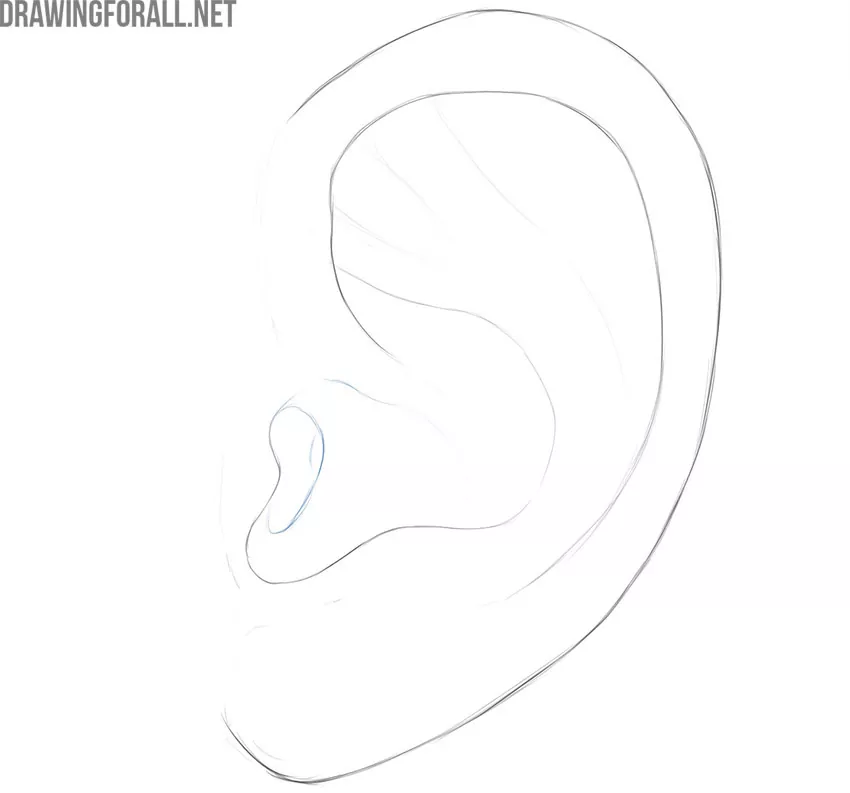
Step 6: Add shadows to the ear
Add shadows to give the ear drawing volume and make it more realistic. Use hatching of different densities and directions to create different degrees of darkness. We explained how to approach light and shadow in more detail in a separate article.
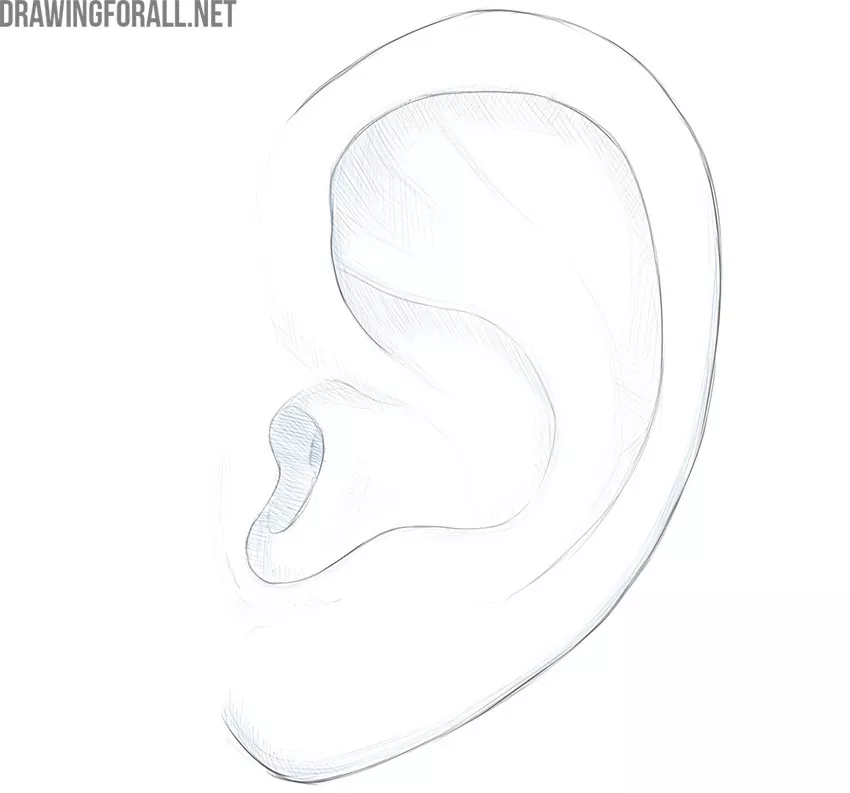
Step 7: Refine the finished ear
Review the finished ear drawing as a whole. Look for any remaining mistakes and correct them where necessary.
We noticed that students often make mistakes in proportions, which can make an ear drawing look less convincing and realistic.
To avoid this, try to maintain the correct relationships from the very first steps, look at the drawing as a whole, step back from it, and check it in a mirror. These methods will help you spot mistakes in time and correct them.
It is also very important to depict the shadows correctly. Start with the darkest areas, then gradually add mid-tones, cast shadows, and lights.
When drawing a cast shadow, keep in mind that it reflects not only the shape of the object itself but also the shape of the surface on which the shadow falls.
It should also be remembered that for the most convincing form, hatching should follow the shape of the subject. This will help give the ear drawing a more three-dimensional appearance.




: )))))) I like the way you explain in your tutorials….
Nice one I really n honestly appreciate for helping me Tnx