

How to Draw Candy
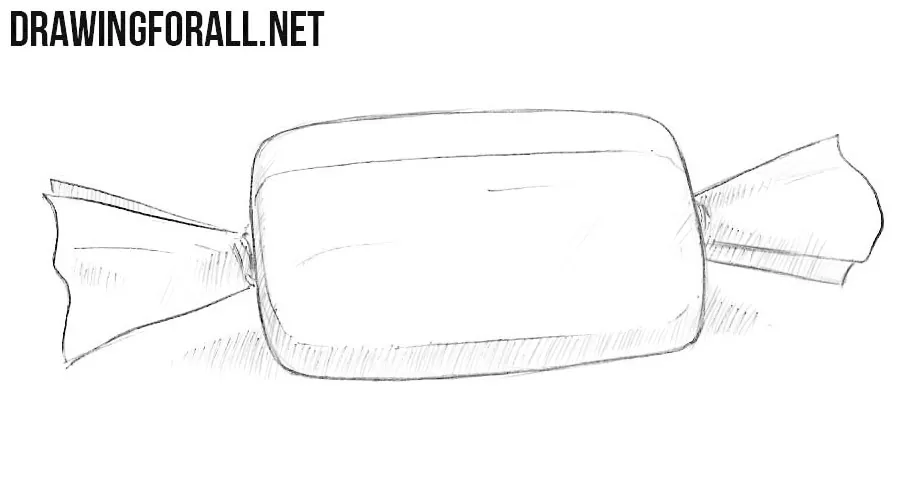
Candies can have completely different shapes, with different wrapper outlines and various designs on the surface. In this tutorial, you will learn how to draw a candy with a rectangular shape, a simple wrapper, and no logos.
Using this basic form, you can add any logo you want or change the shape of the candy itself.
How to draw candy step by step
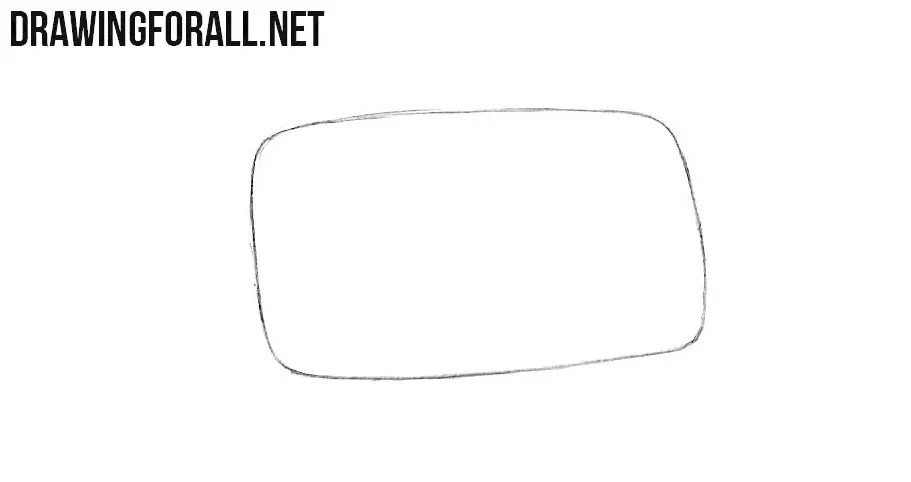
Step 1: Sketch the candy’s basic shape
First, draw a rectangle. The corners should be rounded, and the lines should be very light. At the same time, remember that when drawing this rectangle, you are actually depicting an elongated horizontal cuboid, a form similar to a small brick.
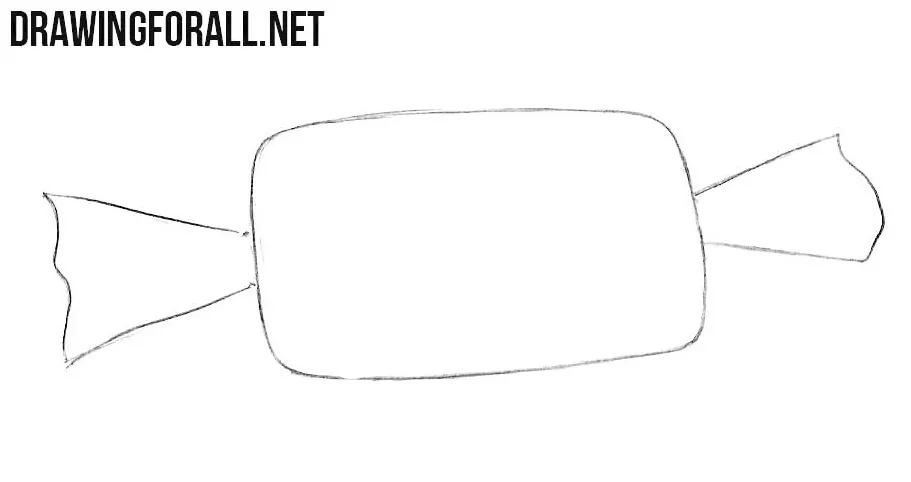
Step 2: Outline the candy wrapper ends
Now sketch the ends of the wrapper with a few simple lines. Make the shapes narrow at each end where it meets the candy. Spread its edges outward into a fan shape. Sketch the outer ends with uneven, wavy lines. Place the left end slightly lower than the right.
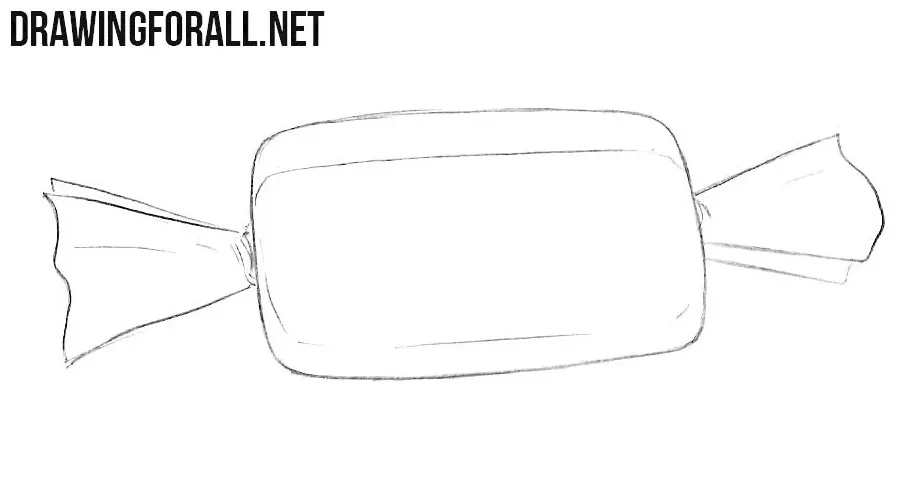
Step 3: Draw wrapper edges and folds
Using a few simple lines, draw the cut edges of the wrapper. Draw a long curved line inside the candy’s upper edge and a lighter line near the bottom to define its front surface. Also, add some folds to the wrapper. Outline a narrow overlapping strip along the upper left end and beneath the right end. Add short creases at the pinched connections.
Step 4: Add shadows to the candy
To complete the candy drawing, add some shadows using dense hatching. Shade along the lower and left edges of the candy, then darken the pinched wrapper folds and overlapping strips. Add lighter strokes across the loose ends and a short cast shadow beneath the candy. Leave most of the front surface white.
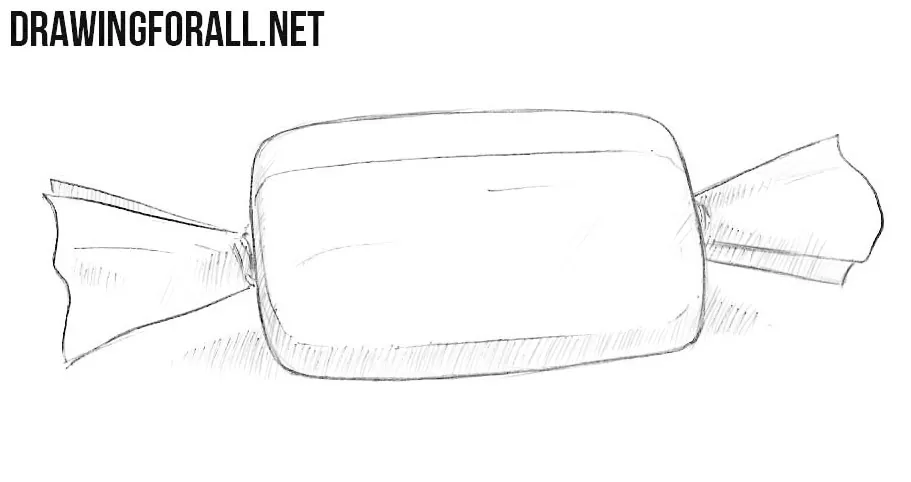
Again, a candy can have almost any shape, but most often the candy inside the wrapper will be rectangular, square, or round.
The twisted ends of the wrapper on the sides create additional volume. This is the basic construction of a simple wrapped candy. The sequence of steps you saw above can be applied to drawing almost any variation.
Additional logos, lettering, and patterns are up to you, but add them with the form in mind. They should curve where the form curves and remain straight where the surface is flat.
When drawing a lollipop, you can see a similar principle: the stripes curve according to the cylindrical form of the candy rather than simply lying across it as straight diagonal lines. When drawing a chocolate bar, you can also see how elements behave one way on flat planes and differently on curved surfaces.


