How to Draw a Dolphin

With this tutorial, you will learn how to draw a dolphin in a characteristic pose of jumping out of the water in a realistic style.
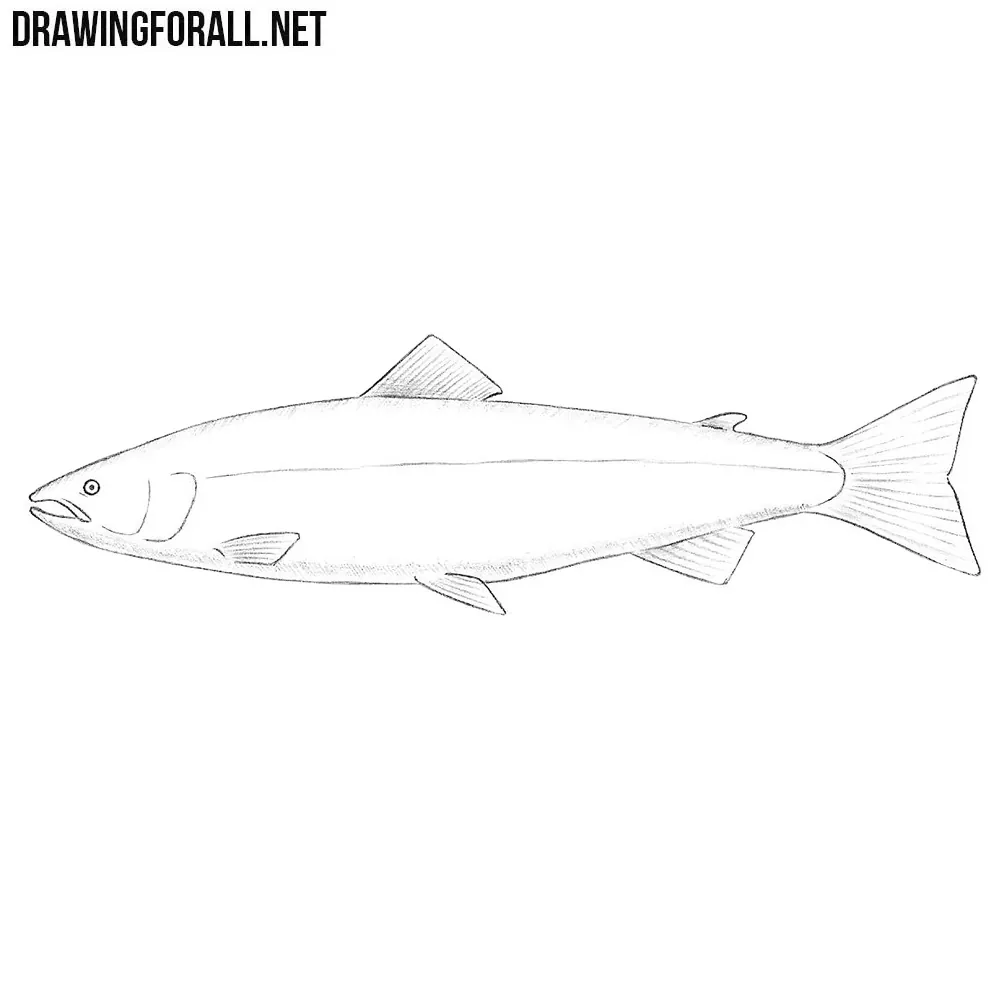
Although a dolphin is a mammal, it shares many characteristic features with fish in terms of form and structure, and the drawing process is very similar.
When drawing a dolphin, as with drawing a fish, it is helpful to think of the body as an elongated, modified cylinder, with the fins represented as flattened, box-like volumes.
These forms do not need to be drawn in detail at every stage; it is enough to keep them in mind during the construction process and indicate them as general masses.
How to draw a dolphin step by step
Step 1: Block in the body with a curved shape
Keep the volumetric nature and the cylindrical base of the animal’s body in mind, and sketch the overall outline using a light, long, smooth geometric shape. Make the body thicker in the head and torso area and narrower toward the tail. Add a slight curve to create a more natural pose.

Step 2: Draw the dolphin snout and eye line
At the front of the body, indicate the elongated, smooth snout of the dolphin, remembering that it is also based on a cylindrical, three-dimensional form. Slightly above, mark the eye line. Make sure that the dolphin’s body and its snout follow the same axis and lie in the same plane.

Step 3: Sketch the dorsal and pectoral fins
On the upper part of the body, draw the dorsal fin of the dolphin as a smooth, slightly curved triangular shape. On the underside, add two more fins, placing them at a slight angle and giving them a similar triangular form. The far fin is partially overlapped by the dolphin’s body, which should help create additional depth in the drawing.

Step 4: Draw the tail of the dolphin
At the end of the tail, draw the tail fin of the dolphin consisting of left and right parts. Following the principle of linear perspective, the part closer to the viewer should appear slightly larger than the one farther away. Both parts should remain symmetrical in shape, with only a subtle difference in size.

Step 5: Draw the eye and mouth of the dolphin
Using the guideline drawn earlier, sketch the dolphin’s eye as an almond-shaped form. Draw the mouth, giving it a characteristic curve, and refine the outline of the snout with clearer lines, connecting it smoothly with the head.

Step 6: Refine the pectoral fins with smooth lines
In the same way, refine the outlines of the pectoral fins, giving them a smoother and more seamless shape. Gradually erase construction lines as you go and add small folds where needed. Here you can enhance the effect of atmospheric perspective by making the far fin slightly lighter than the near one, creating additional depth.

Step 7: Clean up and refine the dorsal fin
Refine the dorsal fin, making its connection to the body smooth and natural. As you add details, compare them with the overall proportions to maintain a cohesive look.

Step 8: Refine the tail fin and adjust its angle
Move to the tail and refine the fin, correcting and improving its shape and proportions as needed. Make sure the tail is positioned at a convincing angle relative to the rest of the body.

Step 9: Refine the full dolphin outline
Go over the entire dolphin drawing, refining it with smoother, cleaner lines. The figure should look streamlined, with all parts flowing naturally into one another.

Step 10: Clean up the dolphin sketch
Erase any remaining construction lines, being careful not to remove final lines. At this stage, you can also add additional details if needed.

Step 11: Shade the eye and block in shadows
Shade the dolphin’s eye, leaving a small highlight. Then indicate the shadow areas, following the form of the body and the direction of the light.

Step 12: Draw shadows on the dolphin
Carefully shade the shadow areas, making the core shadow slightly darker than the halftones. Add light tone to the fins and other areas where needed. You can also add subtle highlights to the body. Try to apply hatching in accordance with the form and volume it follows.

Step 13: Check proportions and unify the drawing
Finally, check your drawing to make sure everything looks correct. Unify the entire image by identifying any parts that stand out and adjusting them so the drawing appears complete and cohesive. Make sure that the tonal relationships are correct, with shadows clearly distinct from the light.

Advanced dolphin drawing practice
As mentioned earlier, a dolphin can be understood as a volumetric cylindrical form, with fins represented as flattened, modified box-like shapes and the snout as a smaller cylinder.

Why is it important to think this way when drawing a dolphin?
This volumetric approach comes from the principles of artistic vision and helps you understand and analyze what you are drawing, rather than simply copying outer contours.

It is also essential when adding shading, because understanding the underlying volume makes it much easier to place shadows correctly and convey a three-dimensional form.
Knowing these volumes also allows you to draw dolphins more freely in different angles and poses, since you are not limited to copying outlines but can construct the form with confidence.

Keeping these principles and a general understanding of the animal’s volumes in mind, you should try to draw the dolphin in different poses and variations. This is what will help you refine your skill and build confidence.