Human Head Proportions
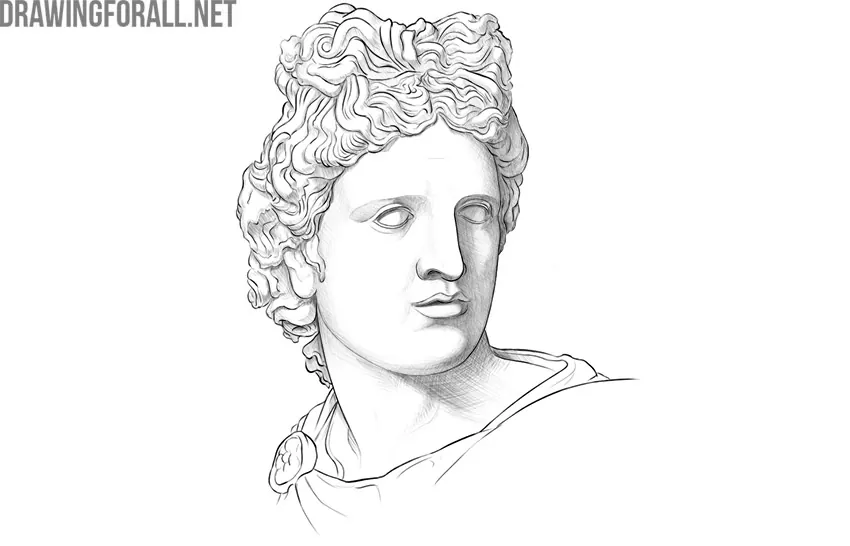
Proportions are extremely important in drawing, and the proportions of the human head are especially important in drawing portraits. In this article, we will tell everything you need to know about it to create convincing portraits.
Note that here we give the proportions of classical norms and canons. That is, we will talk about averaged proportions.
The proportional canons of antiquity do not always coincide with the proportions of an ordinary person, but the principles underlying them are the same.
It is very important to understand that all people are different, and our proportions vary from person to person. If we were all the same and looked like canonical Greek sculptures, then life would not be so interesting, would it?
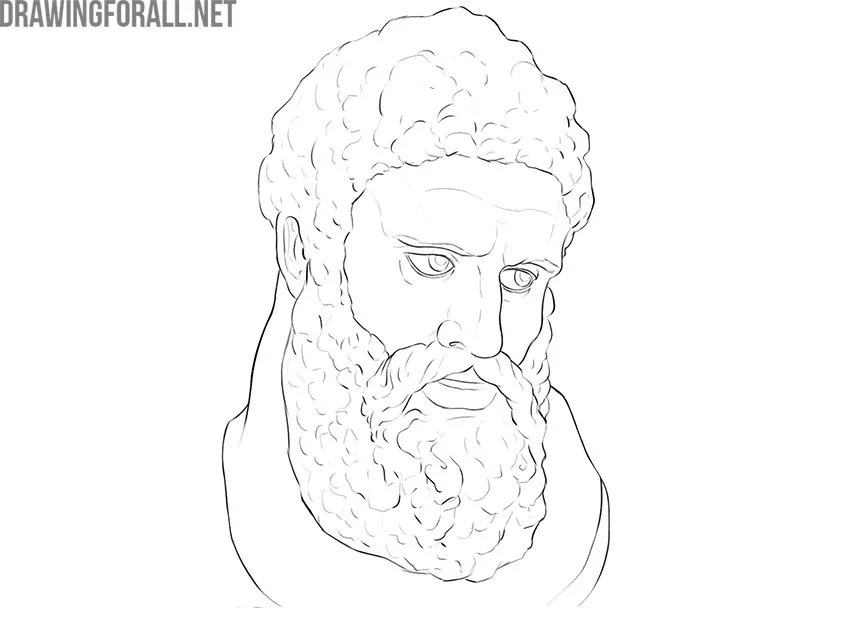
The human head is a measure by which the rest of the body can be measured. Using the height or width of the head, you can measure the height of the body and the length of the arms, legs, torso, and other parts.
If we consider the human skull anatomy, the shape of the head is formed by two main parts – the cranium and the facial skeleton. The cranium occupies about 2/3 of the head, and the facial skeleton occupies about 1/3.
Let’s look at the sizes and proportions of the head from three views – front, side, and top. When looking at the head from the front, we can see that its width relative to its height is about 1:1.7. The horizontal line of the eyes is at the middle of the height of the head, excluding the hair.

The distance between the widest points of the zygomatic bones corresponds approximately to the height of the facial part, from the base of the chin to the bridge of the nose. The ratio of the height of the head to its diagonal is approximately 1:1.8.
The height of the facial part of the head is divided into three equal parts. The first is from the tip of the chin to the base of the nose, the second is from the base of the nose to the glabella, and the third is from the glabella to the middle of the frontal bone, or about one and a half to two fingers above the frontal tubercles.
The width of an eye, the distance between the inner corners of the eyes, the width of the wings of the nose, and the width of the tip of the chin are approximately the same.
The line of the mouth is located about 2/3 of the distance from the base of the nose to the tip of the chin. The width of the mouth corresponds approximately to the length of the nose, from the bridge to the base of the nose, and to the distance from the mouth line to the tip of the chin.
Pay attention to the position of the bridge of the nose. It is located approximately at the level of the upper eyelids, not at the level of the middle of the eyes, as many mistakenly believe.
The ear and nose are approximately the same height and are located at roughly the same level. In other words, the upper edge of the ear is at the level of the bridge of the nose, and the lower edge is at the level of the base of the nose. The height of the ear is approximately equal to the distance from the ear to the outer end of the eyebrow.

Note that all these proportions apply when the face is at eye level and looking directly at us. When the head is tilted or its position in space changes, these proportions will appear distorted according to linear perspective, which the artists of Drawingforall.net discussed in one of our previous articles.
So, how can you put this knowledge into practice? Before you start drawing, first outline the overall volume of the head as an oval.
Mark the horizontal eye line and the vertical line of facial symmetry, then gradually indicate the location of the facial features, taking into account all of the proportions described above.
In this article, the team of Drawingforall.net told you about the most important principles of human head proportions.
As mentioned above, this knowledge is very important if you want to draw realistic and convincing portraits. To develop these skills, draw as often as you can. Knowledge is important, but regular practice is what helps you become a better artist.