

How to Draw a Ball
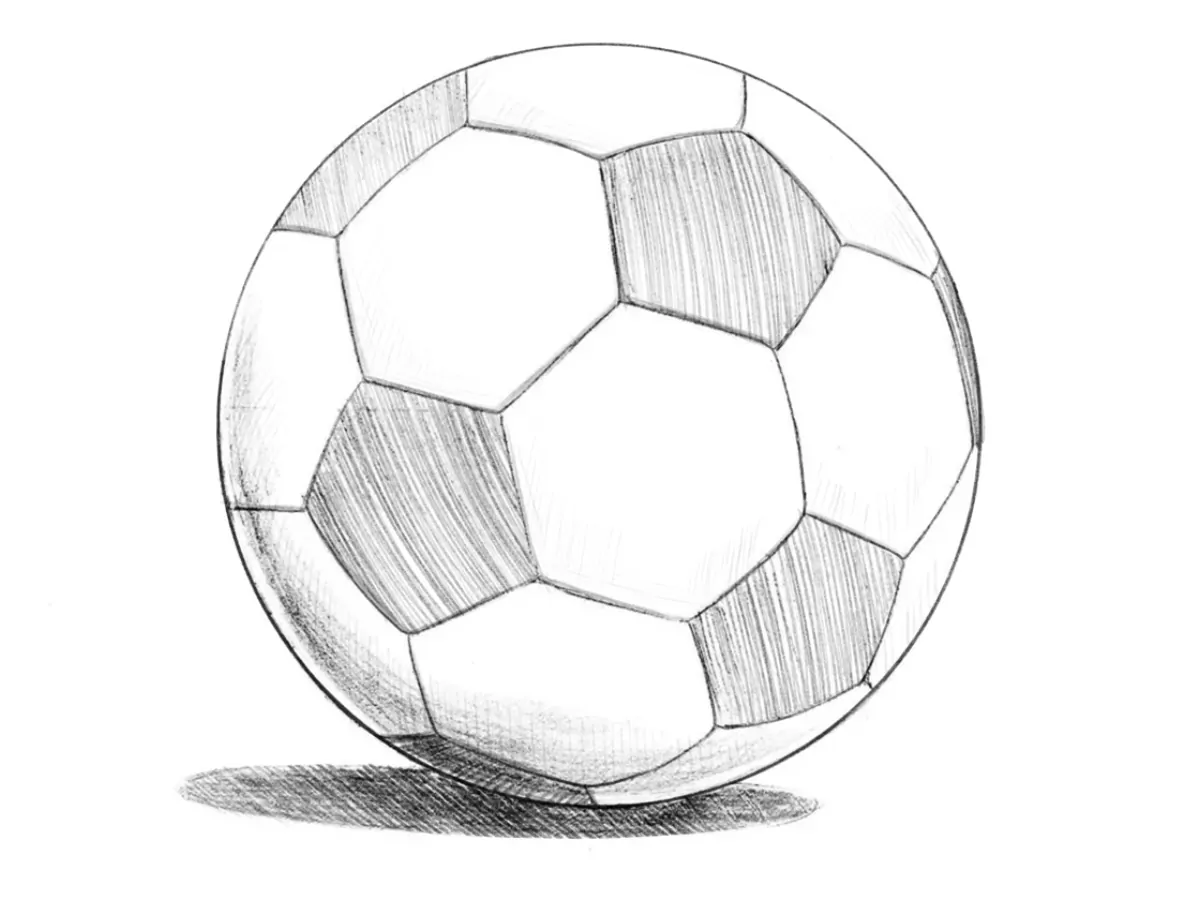
In this lesson, we’ll show you how to draw a ball using the example of a classic soccer ball made of black and white hexagonal panels.
The foundation of drawing a ball is the classic sphere – a three-dimensional, round form. This is one of the most basic and important geometric shapes for any artist, and it’s one of the first forms artists learn to draw with a sense of volume.
The only noticeable visual difference between a ball and any other sphere is its surface texture. In our example, we use the pattern of a soccer ball, but you can apply other textures to draw a basketball or a volleyball.
The most important thing to remember when drawing a sphere is that you are depicting a three-dimensional object, not a flat circle.
Because of this, both the texture and the shading should always be applied with the form of the sphere in mind.
How to draw a ball step by step
Step 1: Add vertical and horizontal guides
Even though we’re drawing a three-dimensional sphere, the first step is to sketch a perfectly round circle. To do this accurately and symmetrically, draw cross-shaped symmetry guidelines. Start by drawing a perfectly vertical line, then intersect it at the center with a horizontal line of the same length.

Step 2: Draw a clean, even circle
Now mark points at all four ends of the construction lines, keeping them at an equal distance from the center. Then connect these points with a smooth, even circle, making sure it is as symmetrical and accurate as possible on all sides. To check the symmetry, you can look at the drawing in a mirror or turn it upside down.

Step 3: Remove the construction lines
Now erase the construction axes from the first step, being careful not to touch the outline of the circle itself. Then check the symmetry and accuracy of the entire ball drawing and correct any mistakes if necessary. You can also trace the entire shape with a darker, cleaner line.

Step 4: Draw the first pentagon of the ball
Start adding the texture, keeping in mind that this is a three-dimensional sphere. First, draw a pentagon in the lower-right part of the ball. Remember that this shape should curve and appear visually distorted because of the spherical surface it lies on.

Step 5: Add more surface panels
Now, using the position and size of the first pentagon as a reference, add several more, again keeping in mind the volume and shape of the sphere itself. Make sure the perspective of the pentagons changes according to their placement on the spherical surface. A soccer ball has large and small panels. The white panels on a soccer ball are slightly larger than the black ones.

Step 6: Draw the final ball panels
Now, using the same method, draw the remaining parts of the ball pattern. Since these sections are located near the visible edges of the ball, they will be only partially visible. In addition, because of perspective, these shapes should appear slightly smaller than the ones you drew in the previous steps that were closer to the center.

Step 7: Shade the panels and add shadows
Since we’re drawing a classic European soccer ball, some of the pentagons need to be filled in with a dark color, while others should remain white. Use even, smooth shading to fill in the black panels. Then add shadows to the lower part of the ball and draw a cast shadow directly beneath it.

This ball drawing lesson is entirely based on the fundamentals of drawing a sphere and represents an important step after learning the basics of geometric forms.
In other words, once you’ve learned how to draw simple, empty geometric shapes such as spheres, cubes, cylinders, and similar forms, the next stage is to draw objects that use those same forms but include surface texture.
Objects like soccer balls, boxes, and other simple shapes are ideal for making this transition and moving to a more advanced level.
It’s important to keep regular practice in mind. When drawing a sphere or a soccer ball, you shouldn’t stop at a single result.
You should consistently practice drawing different forms and textures. For example, you can draw a volleyball or a basketball using the same principles, but with a different surface pattern.
You can also change the form itself and draw an American football, which has a noticeably different shape. All of this will help you steadily improve your drawing skills and build a more versatile visual toolkit.




this was a lit soccer ball drawing tutorial
Thanks! Glad you enjoyed the ball drawing tutorial.
Great
Thank you.
This one is actually so easy!
Glad it felt easy to follow.
This one is actually so easy! I love how simple and easy to draw this is
Thanks! Keeping it simple was the goal.
So Easy!
Glad to hear that.