

How to Draw Broccoli

This step-by-step tutorial will show you how to draw broccoli and share some important basics of drawing vegetables.
Broccoli has a very distinctive appearance, with a wide, lush top and a stalk that resembles a tree trunk.
We will show you how to draw broccoli using the basic principle of moving from general shapes to specific details, and at the end we will give a few useful tips for practicing the skills you gain.
How to draw broccoli step by step
Step 1: Sketch the broccoli top mass
So, broccoli consists of two large masses – the upper part and the lower part. In simplified form, the upper part looks like a large sphere, and the lower part like a cylinder. Start with the top and sketch a large circle or oval using very light lines.

Step 2: Draw the broccoli stalk shape
Now sketch the lower part, the broccoli stalk, in the form of a cylinder or a rectangle slightly narrowing toward the center. Do not try to draw a perfectly even cylinder, since organic forms are rarely perfectly symmetrical.

Step 3: Divide the crown into smaller clusters
Begin dividing the large forms into smaller ones while still using very generalized outlines. Starting with the upper part, add the contours of individual broccoli clusters, slightly varying their size and keeping in mind that they are arranged on a spherical surface.

Step 4: Mark the branch connections
Next, add the outlines of the individual branches in the upper part of the stalk where it connects to the top of the broccoli. The thickness and angle should not be identical for all of them, so that the broccoli drawing looks more natural and authentic. Now add short crosswise lines on the stalk.

Step 5: Refine the broccoli crown contours
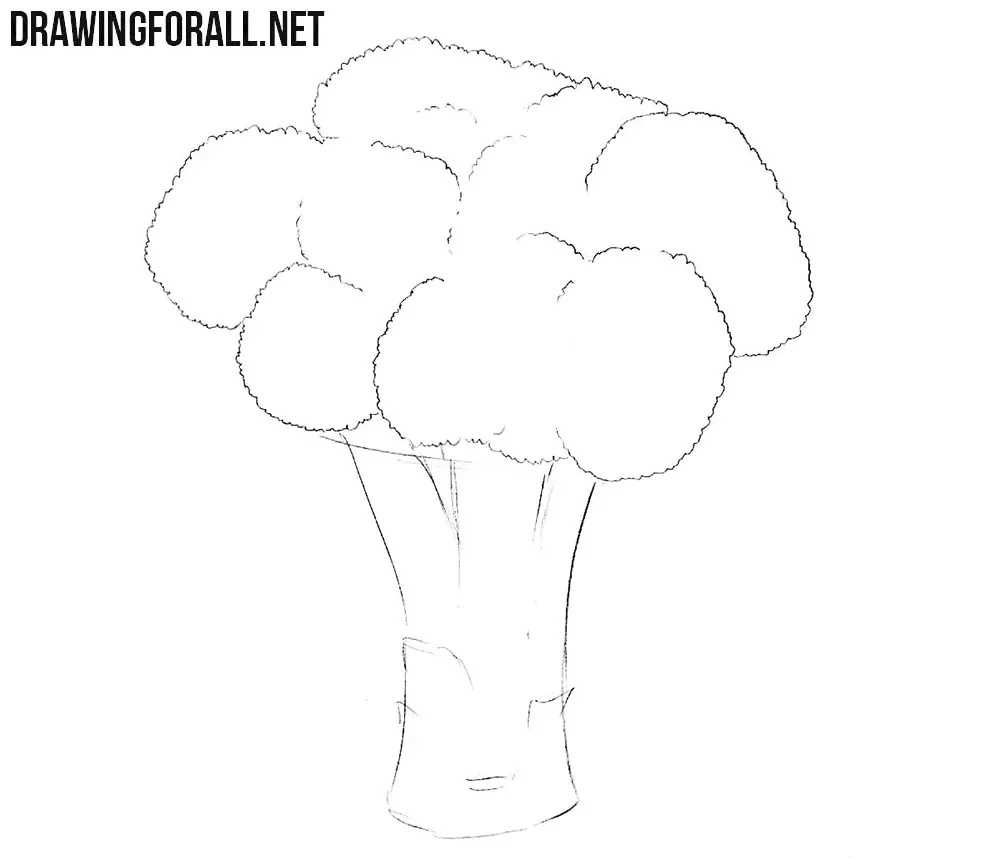
Move from the general forms to more specific and final details, refining the curly outlines of the upper half of the broccoli with darker finishing lines. Keep in mind that all these shapes are parts of a large spherical form and should follow the same surface as the main mass.
Step 6: Draw the broccoli stalk in detail
Finish the lower half in the same way, carefully refining and outlining the previously sketched contours while gradually erasing any unnecessary strokes that are no longer needed. Here you can also add additional details to the stalk or the crown of the broccoli.

Step 7: Add shadows to the crown and stalk
Assume that the light falls on the broccoli from above and from the right; accordingly, you should shade the areas of the crown and the stalk that do not receive light. As you carefully add hatching, remember to follow the form of the overall mass of the broccoli as well as its individual parts so that the drawing looks cohesive.

In appearance, broccoli resembles a tree; the overall form and construction in the early stages are quite similar. A similar principle to the one you saw in this tutorial was also demonstrated in our tree drawing lesson.
You first create the general masses of the upper and lower parts, then gradually refine them by adding smaller forms and breaking them down into even smaller ones.
At the stage of breaking the forms into smaller parts, you can experiment significantly, making the outlines of both the top and the bottom more varied.
You do not need to exactly replicate the shapes shown in our example. To practice drawing broccoli, try sketching it several times in a row, changing the upper and lower parts each time.
The angle we chose is not the only possible option. You can place the broccoli on its side or, for example, draw several pieces arranged one behind another, slightly overlapping.
This will be another useful exercise for developing your skills. Try drawing several broccoli heads of different shapes placed next to each other and slightly overlapping.
In doing so, you will also practice combining elements in a still life and deepen your understanding of perspective. A helpful exercise is to add something to your broccoli drawing.
After you draw this vegetable, sketch an apple right next to it, add other elements that seem appropriate, and create a complete composition.




just kidding all awesome at drawing
you lot are soooooooo bad at drawing
This helped honestly
This helped a whole lot! Thanks so much!