

How to Draw a Pistachio
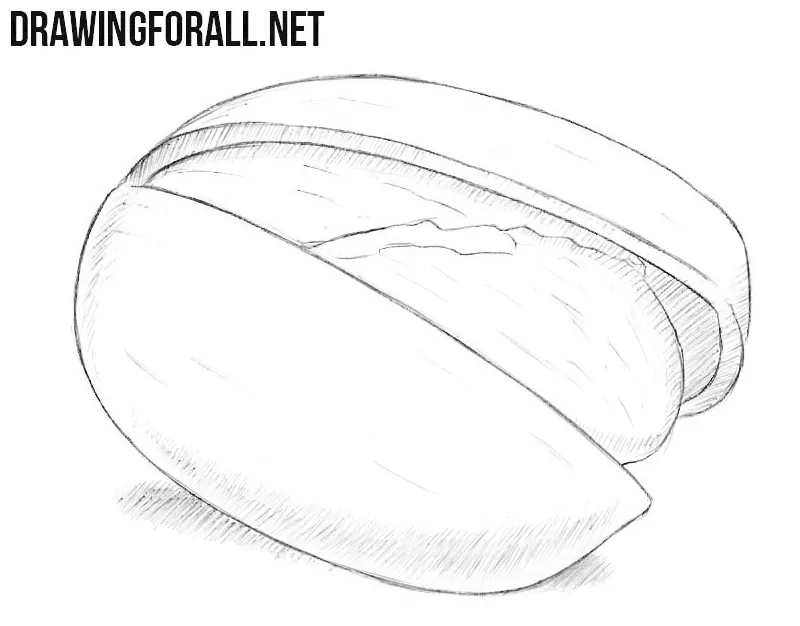
Pistachios can be used in savory dishes, such as salads. They are also used in desserts, such as cakes or ice cream. In this tutorial, we will show you how to draw a pistachio and give you useful skills for drawing not only this nut but also more complex compositions with it.
The main thing to remember before drawing this nut is that it is an irregular three-dimensional form inside a shell. It is very important to convey this, and in the following steps, we will show you how to depict it.
How to draw a pistachio step by step
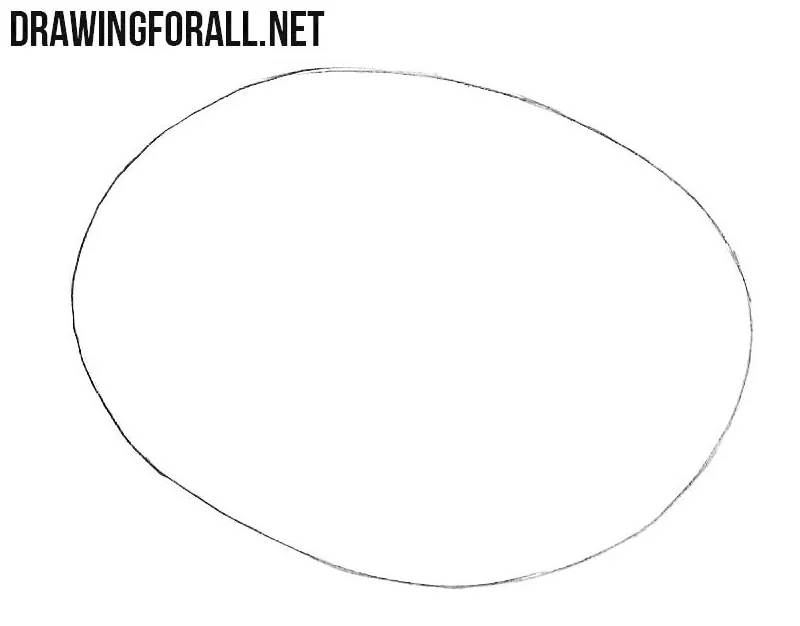
Step 1: Sketch the pistachio shape
First, draw a flattened oval for the pistachio. Place it right in the center of the paper. Note that the nut is slightly angled, so take this into account when drawing the general shape. Most importantly, use very light lines to make them easier to erase later.
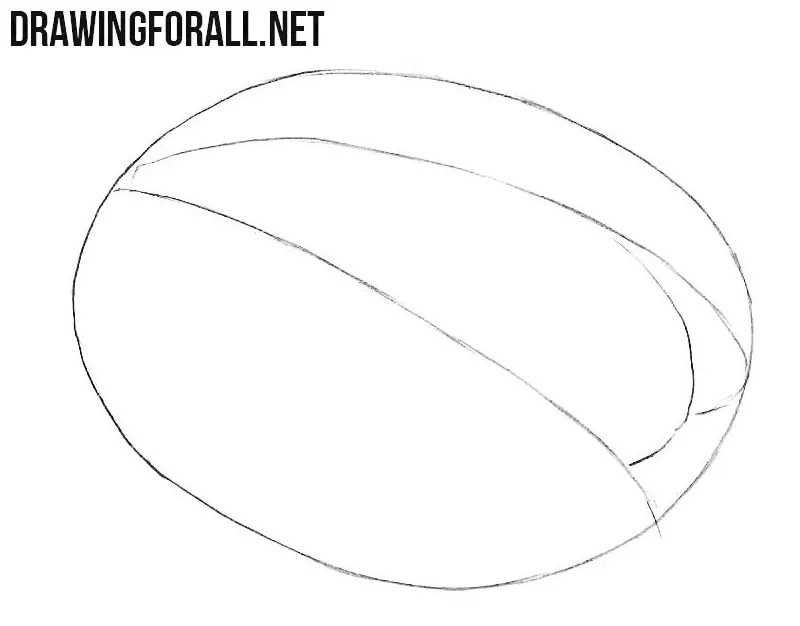
Step 2: Draw the open shell and kernel
Now let’s separate the pistachio shell and kernel. In order not to get confused, first draw the contours of the shell. Mark two long, curved lines that diverge from one point. These lines form the opening between the two halves of the shell, with part of the kernel hidden behind the front edge. After that, draw the pistachio kernel between these two lines.
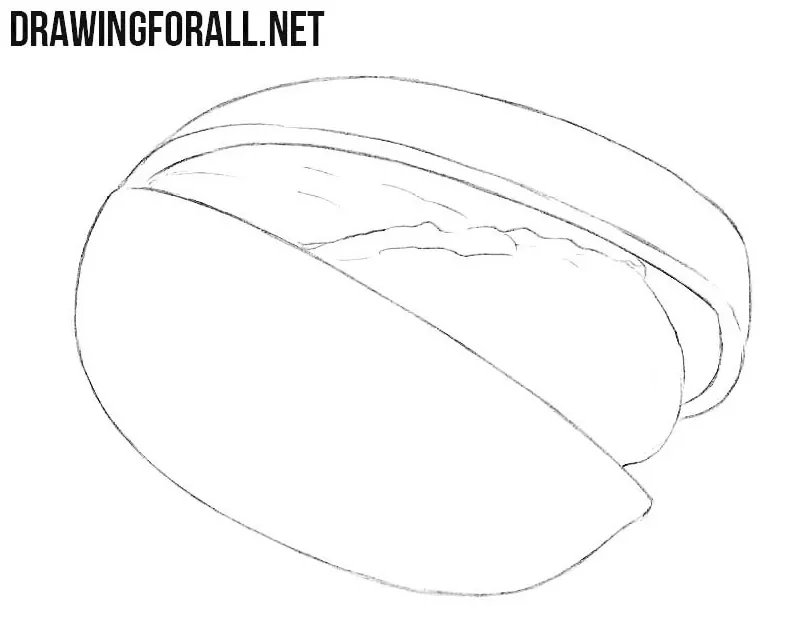
Step 3: Refine the shell and kernel
Let’s now add details to our pistachio sketch. First, add some volume to the shell with a line that follows its contour. This second contour shows the thickness of the visible shell edge and makes the opening look deeper. Then draw a small crack in the center of the nut. Erase the unwanted lines and add some texture. Use a few short, irregular lines on the pistachio shell and kernel rather than covering the entire surface with them.
Step 4: Shade the open pistachio
So this drawing tutorial is almost complete. We just have to work on the shadows. The inside of the open pistachio shell receives less light, so shade these areas with hatching. Next, shade the edge of the shell. Then add a shadow to the lower part of the shell, leaving a small area of reflected light at the very bottom. These contrasts and transitions are what create volume in the drawing. Also draw the cast shadow on the surface beneath the nut.
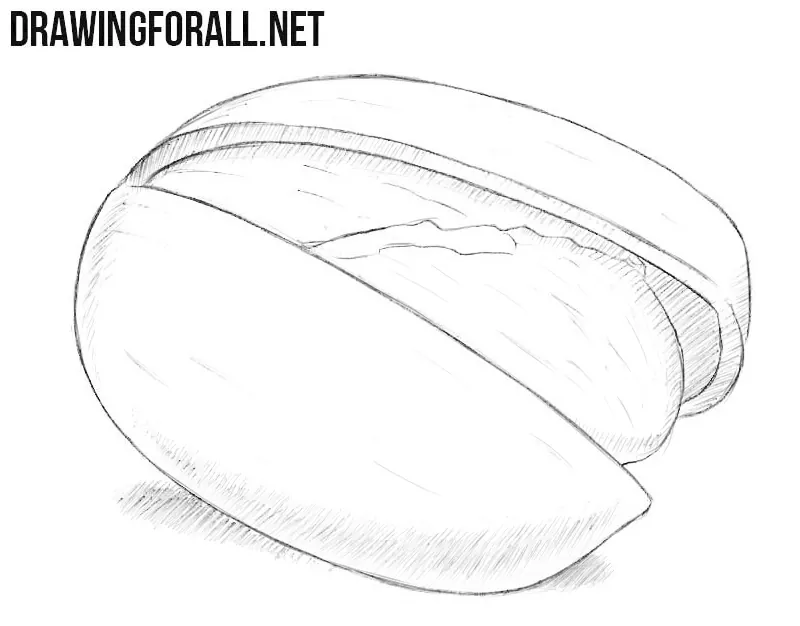
When drawing a pistachio, it is important to correctly convey the difference in textures, as well as the fact that the nut is located inside the shell.
Three-dimensional thinking is extremely important here. A similar principle is used when drawing a walnut in its shell: one three-dimensional form surrounds another.
You can also try drawing the nut without the shell or, conversely, the shell without the nut itself. Or you can try drawing several nuts scattered across a table, with some pistachios overlapping others.


