Lesson 2: Developing Artistic Vision

In this lesson, we will explain how to develop artistic vision – the ability to see the structure and construction of objects and the surrounding world, and to translate that understanding into a drawing on paper.
The world around us is volumetric and three-dimensional; every object has height, width, and depth. In addition, objects contain distinctive features and details that influence how we perceive and recognize them.
An artist must be able to observe and understand these visual qualities in order to represent them in a drawing. However, most beginners do not yet see objects in this way. Instead of observing form and structure, they often rely on familiar symbols.
In this lesson, we will begin training this way of seeing by practicing how to recognize structure, volume, and visual relationships before attempting to represent them on paper.
What is Artistic Vision

First, an artist must learn to see beyond passive images and become aware of form, volume, spatial presence, and the relationships between objects. It is not enough to recognize what the object is; the artist must understand how it exists in space.
A person who is not trained in drawing usually perceives objects and the surrounding environment as familiar shapes without thinking about their structure or visual properties.

An artist, by contrast, sees objects as a combination of forms, volumes, light and shadow, perspective, and spatial relationships. It is this entire set of visual qualities that a beginner must learn to recognize in order to make real progress in art.
When an artist looks at a cup, for example, it is not perceived as a flat image. The artist understands that it is a three-dimensional form with height, width, and depth.

Light falls onto its surfaces, creating value shifts, and the cup itself casts a shadow onto the table. All of this is part of what is being observed.
In a sense, the artist sees through the object. Not only the visible front surface is perceived, but also the implied structure – the hidden side, the continuation of the form beyond what is directly seen. This awareness of the unseen volume is what gives solidity and conviction to a drawing.

Beyond the object itself as a single subject, the artist also understands its relationship to the table and to the surrounding environment – to the objects positioned in front of it and behind it. The cup is not isolated; it exists within space, interacting with other forms around it.
In other words, when you look at an object, you do not perceive it simply as a familiar image; you analyze it and become aware of its structure.

When drawing the object, you are not merely repeating a recognizable symbol or trying to copy what you see. Instead, you construct reality on a flat surface, building a three-dimensional form with its full sense of height, width, and depth.
For example, a person unfamiliar with visual art often draws an eye as a simple almond shape, trying to copy what they think they see. An artist, however, understands that the eyeball is a sphere, that the eyelids have thickness and wrap around that sphere, and that light illuminates the planes facing the source.

In other words, the artist thinks in terms of structure and volume. Rather than copying appearances, the artist constructs on paper what the object actually is.
For this reason, learning to draw does not begin with complex techniques, but with the development of proper visual perception – what is often called training the eye.
This process is closely connected with the development of spatial thinking, which allows an artist to understand the three-dimensional structure of objects and translate it onto a two-dimensional surface.
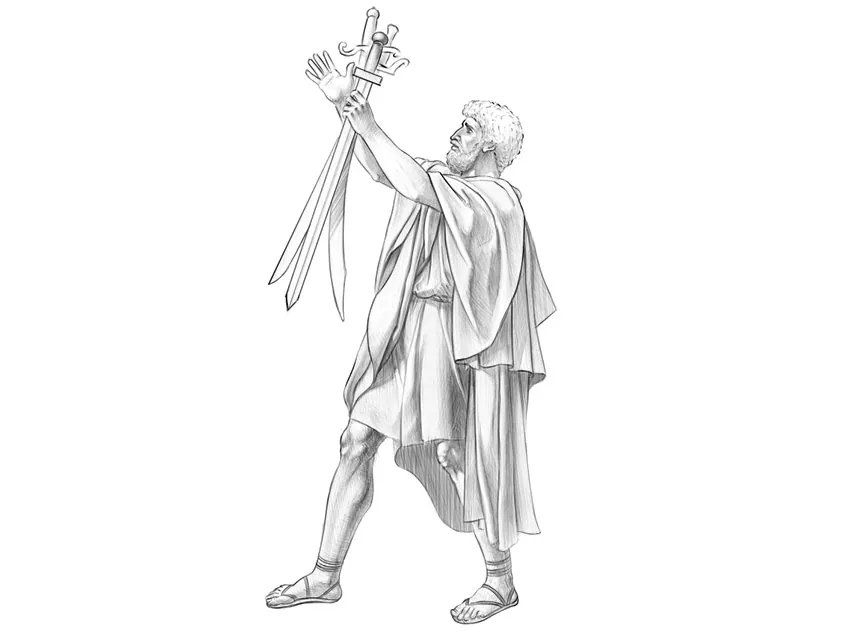
Artistic vision is not an inborn talent but a skill that can be trained. Training the eye means learning to see an object not as a familiar item, but as a combination of forms, masses, proportions, and spatial relationships.
This vision – the ability to look at objects the way an artist does – is what separates a professional from a beginner and ultimately makes it possible to create complete, well-constructed drawings.
How Artistic Vision Works
Seeing the Overall Mass
When an artist looks at a subject, attention does not go to details first. The eye searches for the main mass and overall direction. Before drawing small parts, the large shape and balance in space must be understood. If the general structure is wrong, details will not fix it.

Checking Proportions
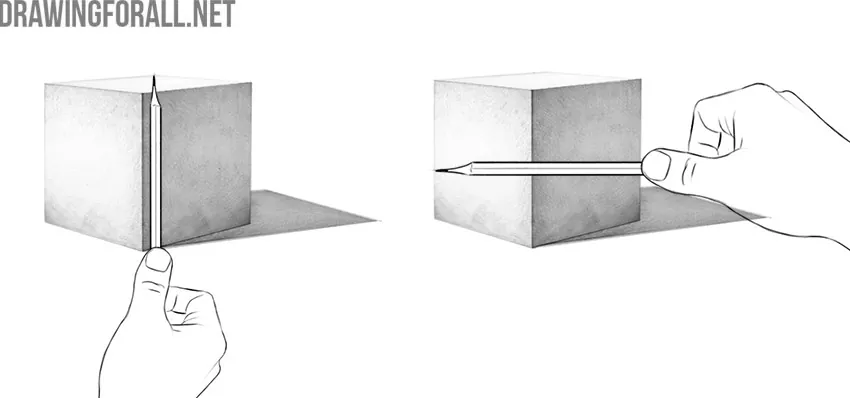
An artist does not guess proportions. Every size and distance is compared to something else. One width is checked against another, heights are compared, angles are verified. The drawing develops through correction. Lines are adjusted until the relationships feel structurally right.

Understanding the Contours and Structure
While drawing an outline, the artist thinks about volume. A curved line is not just a curve – it shows a turning form. A straight edge often marks the change of a plane. The contour is only the visible edge of a three-dimensional construction. The real work happens in understanding the volume behind it.

Reading Light and Shadow
Light and shadow are not added for effect. They explain how the form turns in space. The artist observes which planes face the light and which move away from it. Cast shadows show how objects relate to each other. Shading is used to clarify structure, not decorate the surface.

Seeing Directions and Angles
Every form consists of directional lines. Even rounded objects have specific tilts and axis lines. By identifying these directions, the artist establishes the structural framework of the drawing. Ignoring angles causes a drawing to appear inaccurate.

Maintaining Spatial Awareness
Even when working on a small area, the artist keeps the whole space in mind. What is closer, what overlaps, how forms sit in depth – all of this is constantly checked. No object exists separately from its environment.

Noticing Negative Shapes
A negative shape is the space around and between objects. Sometimes it is easier to analyze than the object itself. For example, the structure of a hand can be clarified by observing the shapes between the fingers. This method helps avoid symbolic drawing.

Integrating All Elements
In practice, artistic vision is not applied step by step. Mass, proportion, structure, direction, and light are observed at the same time. The hand follows this analysis. The drawing becomes constructed, not copied.
How Eye Training Develops
This skill develops gradually through consistent observation and analysis.
Primary methods include:
- analyzing objects as simple forms,
- comparing proportions,
- studying drawings by other artists,
- mentally visualizing volume,
- observing light and shadow without immediately attempting to draw.
It is important to understand that eye training develops more effectively through conscious observation and analyzing than through mechanical repetition.
Artistic Vision: Exercises and Practice
Silhouette Drawing
This exercise trains the ability to see the overall shape of an object before focusing on details. In many cases the silhouette already carries most of the visual information about the form. Working with silhouettes helps develop the habit of recognizing the general mass of an object instead of immediately concentrating on small elements.
- choose a simple object such as a cup, bottle, fruit, or plant
- focus only on the outer contour of the object
- draw the full outline as accurately as possible
- fill the entire shape with one solid tone
- do not add interior lines, shading, or details

Seeing Forms
The purpose of this exercise is to move away from symbolic thinking and begin analyzing objects. Instead of recognizing familiar things, you train yourself to notice the simple forms that construct them. This develops the ability to see the underlying structure of objects rather than their recognizable appearance.
- choose several objects around you
- avoid naming them mentally
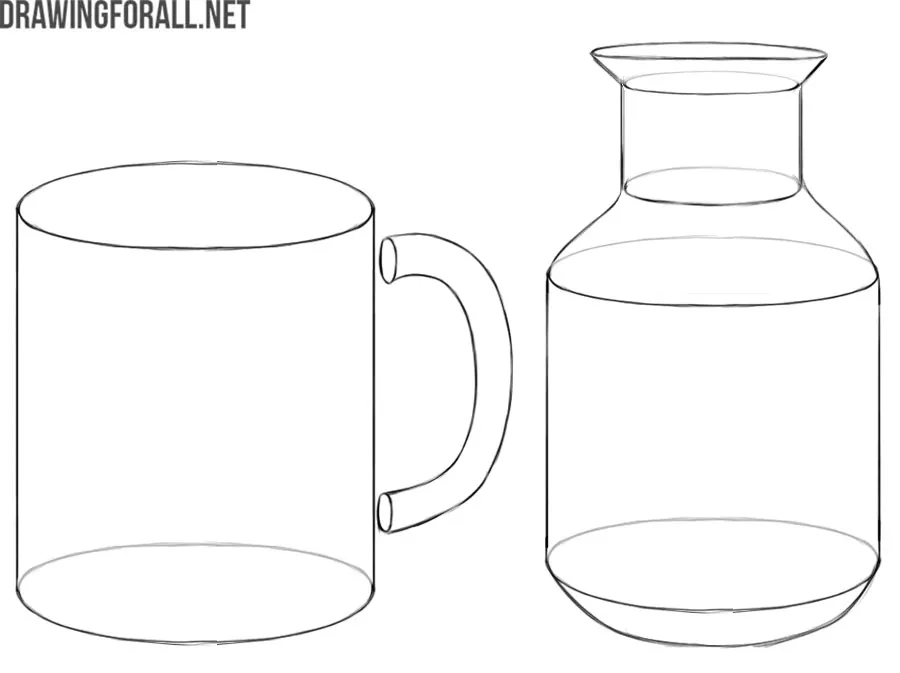
- analyze each object as a combination of simple forms such as a sphere, cylinder, box, or cone
- make a quick sketch using only these geometric forms
- do not add details or textures
Finding Planes
This exercise trains the ability to see the surface structure of an object. Every form, even a rounded one, consists of many small planes that turn toward or away from the light. Learning to notice these planes helps you better understand the volume and construction of the form.
- choose a simple object such as a cup, box, or fruit
- observe how the surface turns in space
- break the object into several flat planes using straight lines
- simplify curved areas by dividing them into angular surfaces
- draw the object as if it were made of flat facets rather than smooth curves

Comparing Proportions
This exercise develops the ability to judge proportions through observation. Instead of guessing sizes, you learn to compare the relationships between parts of an object. Over time this trains the eye to notice differences in height, width, and distance much more accurately.
- place a simple object in front of you
- observe the relationships between its parts
- determine which areas are higher or lower, wider or narrower
- estimate how the size of one part compares to another
- make a quick sketch while constantly checking these proportions
- correct mistakes by adjusting lines rather than erasing them